Monday, 17 September 2018

#ETAD800 Week 2 - Starting in a Good Way

I think this week has been very fitting and great way to start our learning around research methodologies. Thinking about and considering Indigenous ways of knowing has been a part of my work for the past couple of years. While I have learned a lot while working a long side our indigenous team and other colleagues, I am already appreciating learning more from a scholarly standpoint.

When working with Blackfoot elder, Saa’Kokoto, here in Calgary he asked us to reflect through the analogy of a Stick, Rock and a Leaf.
What will stick/has stuck out to you?
What has rocked your world?
What with you leave with?

I will use this way of reflecting as I begin to reflect on my learning

Something that has really stuck out to me already is the importance of the connection to people and place that is placed on Indigenous research methodologies. Something that I am noticing a lot in our schools in Calgary is the importance of place, in learning. This is something that our own community is really focusing on is it has been amazing to see our girls benefit from this. They often make reference to things they have learned about the land and our community in relation to our own family life.

Something that rocked my thinking, as I look ahead to the learning I will do in ETAD800 around indigenous ways of knowing is learning more around the idea of relationality and what this means for classroom teachers as far as truth and reconciliation is concerned. Over the last couple of years I have listened to and read some of Dr. Dwayne Donald’s work around ethical relationality and would like to learn more about this too. I also hear that term come up in Kovach’s work.

As a Kiwi, I feel, and I’m not sure I’m OK to say this, that coming from NZ gives me a slight head start on understanding what truth and reconciliation means for a person from western culture. As a teacher in training we had a fair bit of education around Maori ways of knowing, culture and relations. I felt this preparation in Teachers College prepared me somewhat for the classroom, in which I only taught in for two yers in NZ. All of the work we are doing here in the CBE (and Canada) towards truth and reconciliation reminds me of what New Zealand has been through in the past as a nation.

I am leaving this week feeling optimistic and really looking forward to seeing how learning more about indigenous knowledge/methodology and how it might influence my own work in ETAD as well as professionally, in my work.. As I am focusing this year on developing a research project for ETAD 992, I think this learning will be incredibly timely and will ground me in solid indigenous pedagogy as I head back to work next year.

Wednesday, 21 June 2017

Blog Refresh

Its been too long since I blogged.

This post is acknowledging that I need to start afresh and begin reflecting through blogging again. Recording my ideas and my thinking is a good way for me to document my reflection and also a way to look back on what I've done.

I also start my Masters of Educational Technology and Design in the fall (Hoefully - I'm still waiting on final confirmation) and this will be a good way to reflect about my professional learning.

As I move into my 2nd year as a specialist (I have completed a year in a temporary role and now I begin the first year of my 3 yr contract) I'm finding I have many opportunities to reflect and share my thinking. I don't expect anything back but rather, want to share what I learn as well as use this space to think about my own thinking.

I will start my first post right way...

Saturday, 11 February 2017

Back to our beliefs

Wow, here it is...

It's been 7 or 8 months since I reflected on anything using my blog. Something has been speaking to me lately that it is time to start up again. This is the first of a new burst of posts. As I warm up to the idea of doing my masters, I think I need to dust of the keyboard and get back into writing. There is so much to think about, reflect about and write about. Sometimes I hope to draw, sometimes write. Maybe even find other ways to reflect.

In my new job, as a specialist, I get to work with amazing people. Both the team I collaborate with, and also the teachers I get to learn with too. Visiting over 35 schools in the short 5 months I have worked in this role, has already opened my eyes to many new things.

One of the biggest things I have come to realize in all the work I have done lately, is how we need to continually remind ourselves of the core reason we are in this work. To learn. In our work to help support school in design think, maker education, learning commons, educational technology, learning resources, and whatever else we do in our team, we stumbled across a reminder shared by our #CBEliteracy team about the importance of focusing on our beliefs about learning first. It is important to consider what we know about learning, before we start planning our lesssons/projects, and also choosing our resources. Routman (2014) says our "practices are our beliefs in action" (p.85). He talks about how we often start with resources, then look at our practice and the finally, think about beliefs. He also suggests that we need to do a hard flip of way we do things.

What often happens...


What needs to happen...


I think this is always a good grounding for us as teachers. What kinds of things do we remember as learners. What learning experiences stuck out to us? As Will Richardson suggests in his Ted Talk, we'll all come up with a very similar list.

The following image is one I created a while back, as I reflected on some of the work I had done overthe previous year.  After sharing that image on twitter, it was retweeted a lot. It has turned into the most retweeted tweet I have ever shared. Such a simple idea but something that has resonataed with many!


This is something I am going to continually keep asking and reminding myself.

References:
Routman, R. (2014). Read, write, lead: breakthrough strategies for schoolwide literacy success. Alexandria, VA: ASCD.​​

Monday, 16 May 2016

Hooking Them In!

I'm a big believer in hooking students in to learning. I think it's worth spending time to create something engaging that will hopefully hook their imagination, excitement, curiosity or something inside students so they want to learn more.

Tomorrow I launch a new inquiry around the choices that preteens and teenagers make in their day to day lives. The grade 6 students I'm working with will end up creating infographics that will promote healthy choices.

We will start by watching the following video.


Then we will look at a few symbols and discuss them in the presentation below.


I am also going to make a conscious effort to give the students plenty of time to think and THEN talk. I am going to say very little throughout this task. I want to listen their ideas so I can shape the lessons to follow.


Saturday, 14 May 2016

Designing Icons, Thinking Visually

After a meeting with a colleague this week, I have been thinking more about how I can make my thinking more visible. I would love to bring this in to my teaching more as well. I wonder if all students will benefit from this?

Visual thinking is certainly different than writing down all information. It requires the brain to think a little differently. I'm a very visual thinker. I often think and make connections with things that I have seen or by drawing something to get a better picture of it. I have enjoyed sketchnoting and drawing notes of keynotes and ideas I have come across in my work. I haven't done it as much as I would have liked and would love to make more time to draw. I am currently trying to think more visually. 

This weekend, a group of colleagues have challenged each other to sketch an icon that you haven't used before. I pushed it a little further. I designed an icon for 'evidence capture' as that has been I have been focusing on this week (see note below). My icon consists of four other icons brought into one and represents what it means to gather evidence of learning.

This is my entry in this weekend's #sketchdown. We document learning, we have conversations, we record video and voice to capture learning in different ways.  

In my work this week I have been all about gathering evidence. At this time of the year we are thinking back to work we have done and we start reflecting on how effective how work has been. We also want to share that reflection with others and also celebrate our successes. I have begun recording evidence of learning this year as we have focused on literacy throughout the year. We have come to learn that I this first year of this focus, we have realized that we have probably focused more on reading and writing literacy. We now need to move into more discipline based literacy. This will be an exciting shift as everyone, in their own discipline, will be able to focus on what it means to be literate in Math, or Science, or Music, or in PhysEd.

Monday, 9 May 2016

Sketchnote: Design Thinking

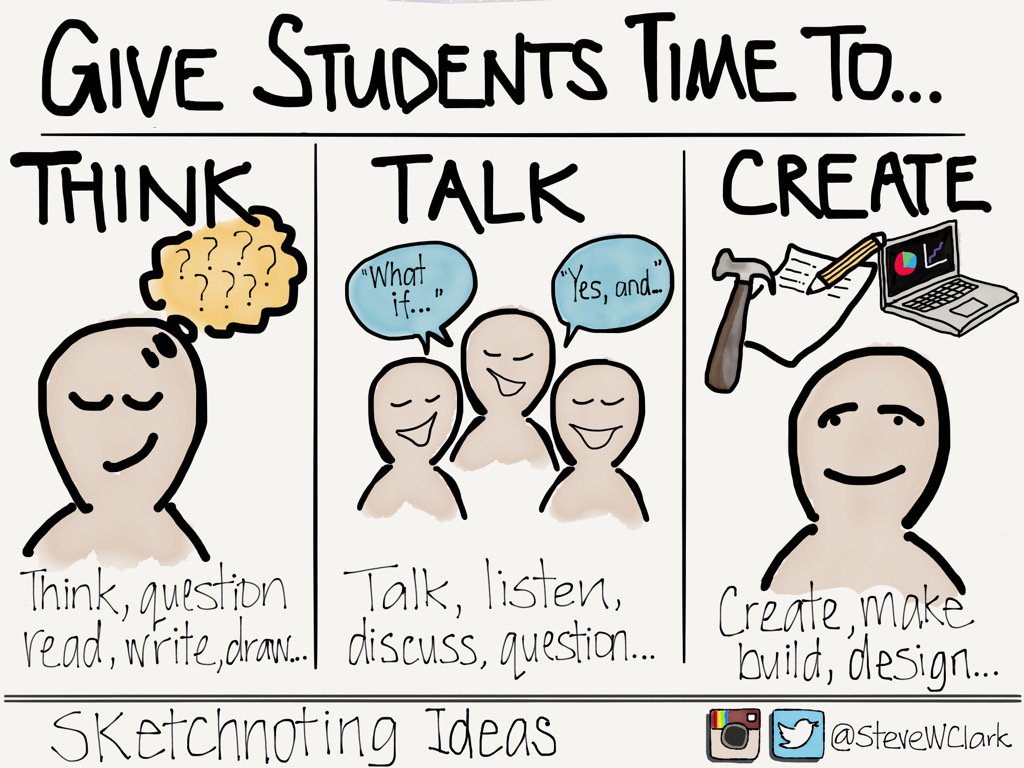
Giving Students Time

Over the weekend I was thinking about things that are important for teachers to remember in this faced paced world of teaching. I thought about time. Do we give enough time to students?

Do we give students enough time to think?

Do we give students enough time to talk?

Do we give students enough time to create?

Do we teach them how to do these three things well? Isn't this all part of being literate in today's world? We need to be able to think about things, so that we know what to say, or know what questions we might need to ask. Then we need time to create something that results from that thinking and talking.

When a colleague and I challenged each other to visualize something that we were passionate about, one of the ideas I thought about was this thing about giving students time. Here's what I created:
https://twitter.com/stevewclark/status/729173094674276352
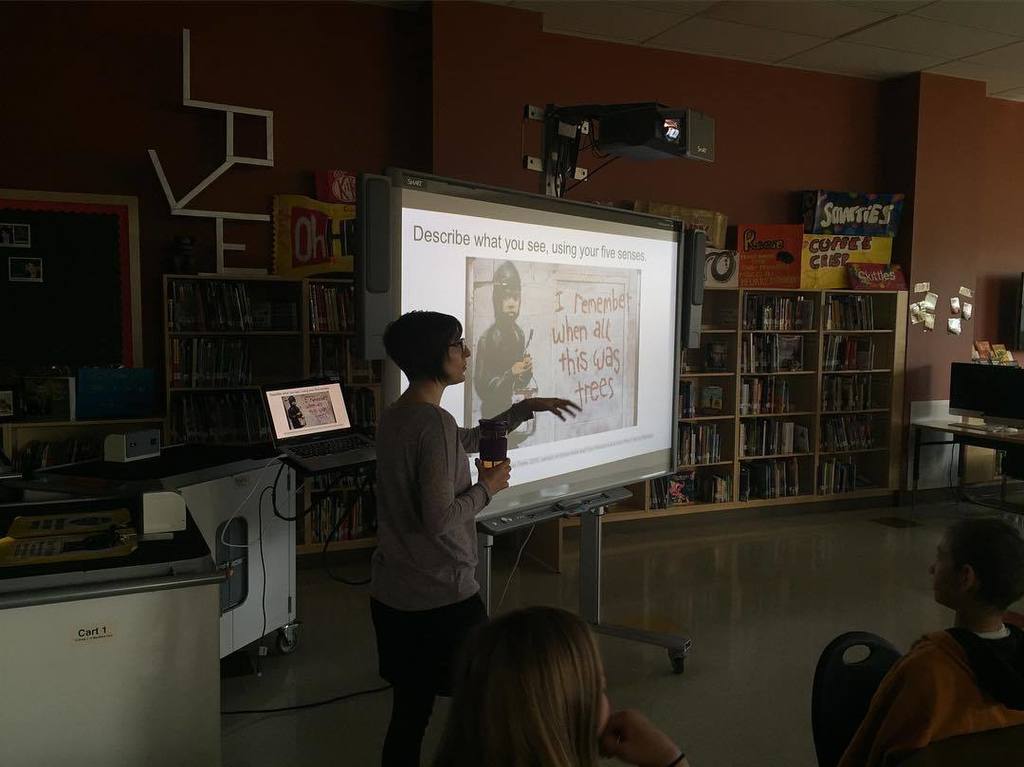
Today, as part of a new project I was apart of at school, my colleague and team member for this project, Ms. Sargent, was running a discussion about a topic we are about dive into in Humanities, Rebellion. Through this task, students were presented with three images from controversial artist, Banksy. She asked students to think about what they knew about rebellion and relate that knowledge to the artwork. The students were given time to do the following:

  1. Look, observe, absorb
  2. Describe what you see using your 5 senses
  3. What connections can you make
  4. What questions do you have about this work of art?
  5. What meaning do you get from this work of art?


This was amazing task. The longer we participated in it, the better the students got at it. We could see and hear more connections being made, we could hear more questions being asked! It was awesome! This was great to experience the success of giving students more time.

Are you giving your students enough time?

Thursday, 26 February 2015

Blogging: DC & the Importance of Respect

To me, one of the most important things to remember when you are blogging is that everyone has different ideas and opinions. While it OK for me to disagree with someone, I still need to remember to respect their opinion.

When we share our own ideas with other people it often helps us understand that idea in a better way. By describing what we think about something we often have to think about other perspectives that are out there. When someone disagrees with my opinion, it often makes me think of other ideas, or perspectives. Sometimes its hard to take/read/listen to other opinions but I need to remember that it’s ok for others to disagree and that we’re all entitled to share our own thinking.

It would be great to get some feedback from this post. I am working with a group of grade 4 students and we are learning about the purpose of comments and engaging with other people's blog posts.

I wonder how other people feel when their ideas are challenged?

Tuesday, 11 November 2014

Authentic, Meaningful & Messy Learning in Music

Our music teacher brought a problem of practice to our PLC the other day.

The task at hand was for students to learn a small piece of music, then get creative with it and recompose a piece by making a few changes to it. The rhythm for the piece was set for them in order to help keep some kind of structure to their work. The instruments they would use would be the class set of glockenspiels and xylophones.

This task bought a problem to the music room. It was messy learning!

You can imagine the noise in the music room when the whole class was practicing and testing their creative composition out. Once this learning task was up and running, the teacher was worried about trying to keep up with all of her students and know where each one was at within the task. She was worried about making sure each one was on task and engaged in their learning.

Here are some of her questions:
How could she ensure that each student was where they were supposed to be in the task? 
How could she ensure that each student was on task?   
How could she monitor and give feedback to every student? 
This task was messy! Were the students actually learning anything? Or was it too crazy and noisy for anyone to hear and learn anything?
Was this task just too noisy and messy for the teacher? Or were the students feeling the same way?
Here is my thinking on this task: 

This is AWESOME learning in music! I don't think it could get much more authentic than this other than each student doing the same thing but in a recording studio and taking away all the noise. In a classroom situation, what else could you do with music? I guess you could have all students doing the same thing, or not have them making any noise. That wouldn't be very authentic then, would it?

I think meaningful and authentic learning, especially in music, will often be (if not always) messy. For this particular task, I think the teacher would feel a lot more comfortable with where her students are at through a slightly different approach creating success criteria, managing the task, and also through intentionally planned feedback loops. 

In our PLC we talked about the need to co-create the criteria at the beginning of the task so all students have a say in what it looks like to be successful. This will enable them to be clear on what is expected and also allow them to track their own learning and take more ownership on what they are trying to do throughout the task.

We also talked about another key to this kind learning might be in the way the teacher manages the learning. I think this goes for messy learning of any kind. The teacher needs to keep pulling the students back in to refocus them and also to give them a chance to share and reflect on what they are currently working on. This strategy would also help refocus those students who might struggle to keep up or get off task with all the noise and busyness of the classroom.

Another important aspect of this task would be intentionally planning multiple opportunities for students to get feedback on their work. These feedback loops might involve themselves, peer and teacher feedback. The feedback would also be given based on the criteria that was created at the beginning of the task.

I think this learning task was awesomely authentic! With a few tweaks to the way it is planned, I think the learning will become more clear and the teacher will also feel more comfortable with what is happening in the 'messy music classroom'.

We hope to try this together sometime soon to test some of our ideas and see if it makes a difference to how the students work, what they learn and what the teacher learns about the learning.

What do you think? Do you have any other ideas? 

Monday, 3 November 2014

What are Feedback Loops?

Today I was chatting to someone on our staff about feedback loops and what good feedback looks like.

One of the questions we came up with was 'if you are focusing on giving feedback all the time, how do you manage it?'. How do you make sure you are reaching all students in your class? ~ From what I've seen, most of the videos and examples I've seen of inquiry projects have been group work projects and therefore were easier to manage the feedback. I'm wondering if this how you make it easier to manage the feedback process, through group work? What do you do when it involves students doing independent tasks? How can we make the feedback process rigorous and well managed when students are working by themselves?

My colleague was also concerned that if she is so focused on giving feedback, she feels like she is not  able to provide her students with the same level of support. My thinking to this is that the feedback and support go hand in hand and that you're providing valuable support by giving feedback. I think there is a misconception out there on what feedback actually looks like. To me, it is dialogue (written or spoken) that helps move that student forward in their learning. The feedback might be direct or indirect communication through the form of 1-1 discussions, group discussions, assessment and success criteria (rubrics and checklists etc). Feedback can not only be given by the teachers, but peers and parents can be included in the feedback loops as well.


Finally, does anyone reading this have access to examples/exemplars or what good feedback looks like? Teachers like concrete examples to help them develop new things in the classroom. It would be great to share some examples. 

Tuesday, 19 August 2014

Wednesday, 16 April 2014

What is Fair?

Image: Unknown original source - This from a post from Joe Bower

Today I had the pleasure of attending a workshop with Damian Cooper, author of Redefining Fair. A book that is about planning, assessment and grading. What a great topic to read and learn more about in today's education climate. In Alberta right now there is so much talk about Education and curriculum and what this is going to look like in the (near) future. We are in the midst of a curriculum redesign where the government is committed to completely revamping the K-12 curriculum so it matches and works for tomorrows students. There is so much talk (some good and some bad) about what good learning and teaching looks like. The public are talking a lot about math and what that should look like in the classroom. There has also been a lot of buzz about no-zero policies and academic awards in junior and senior high schools. 

Today's session was aimed at what we should be doing in the classroom, meeting the needs of our students. It was about the things we do and say to our students. The tasks we ask of our students and how they are assessed. It was about how we should be using the curriculum despite what most educators feel they should do.

Cooper talks about 5 main imperatives. I find these to be very much in-line with Alberta's Teacher Effectiveness Framework by Sharon Friesen. Cooper's take on these are as follows:
  1. Curriculum must be meaningful, coherent and relevant
  2. Instruction must be responsive to students’ needs
  3. Assessment must be informative
  4. Grading must blend consistency with professional judgement
  5. Communication about learning must be truthful and transparent
The main points that I took away from today's workshop can be captured in the following Storify:

Thursday, 10 April 2014

Personalization

I saw this tweet from Davis Truss (@datruss) this morning and it resonated with me.  It shows three great metaphors of what good learning and teaching looks like. I think these are the things we're trying to do to help change education for the better! And what's best is that they're all student focused!